How to understand the markings on your Tractor tires?
Each MAXAM Tractor tire’s sidewall includes important markings called the nomenclature which details the following: tire size, tread, load index (weight carrying capability), speed rating, and any additional safety or mounting requirements. These details can help you make an informed tire purchase, ensure proper fitment, and help you assess your tire’s optimal use in any farming or construction equipment application.
Tire Size
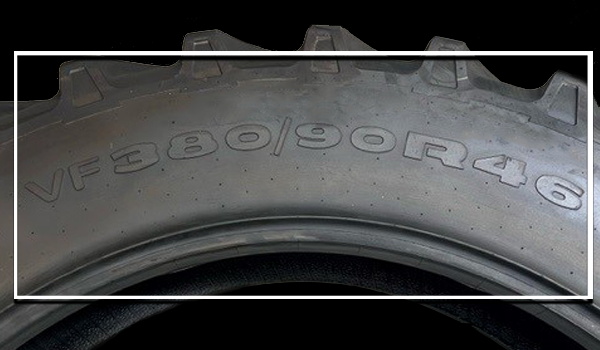
On your sidewall, you will find your tire size. To help you understand what each item means please see the below example.
Tire Size Example:
- VF – This tells you that this product is not a standard Ag tire but part of our VF (very high sidewall flexion) series. Not all tires will have this VF nomenclature on the sidewall.
- 380 – this tells the nominal section width or tread width in millimeters. This is the measurement from one shoulder to the other shoulder.
- 90 – this is the aspect ratio. Which is equivalent to 90% of 380 mm = 342 mm measure from the bead area to the shoulder. The lower the ratio, the taller the sidewall height in relation to the tread width.
- R – The letter R indicates radial construction. A bias-constructed tire uses a dash (-) instead of the letter R.
- 46 – this indicates the rim diameter and means this tire would fit a rim with a 46-inch diameter.
Load Index Number and Speed Rating
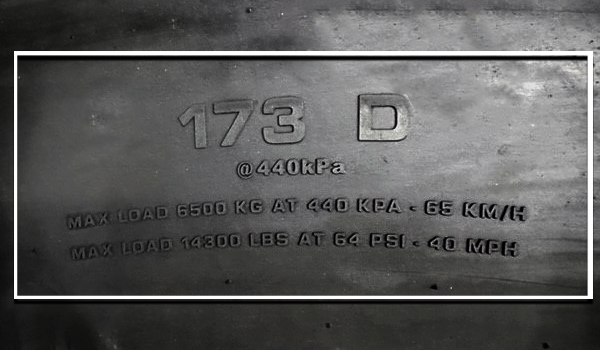
The load index is the two or three-digit code that indicates the load-carrying capacity of the tire. Maximum load goes closely together with the speed states by the speed symbol. Together these numbers can be considered a variable performance rating.
- 173– this is the load index of the tire or otherwise known as the tire’s maximum load-carrying capacity measured in Kilos (KGs) or Pounds (LBS)
- D – or D ratings stand for the speed category of the tire. This letter will change per speed category and can be broken down by the below table:
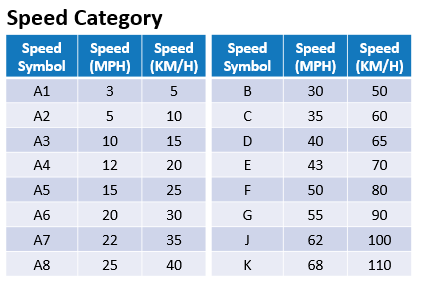
- Max Load – Maximum load carrying capacity will be listed on the sidewall in both metric (kilos) and imperial (pounds)
- Speed Rating – Maximum speed for a tire will be listed on the sidewall in both kilometers and/or miles-per-hour.
ADDITIONAL SIDEWALL MARKINGS & LABELS:
Bead Seating and Safety Warnings
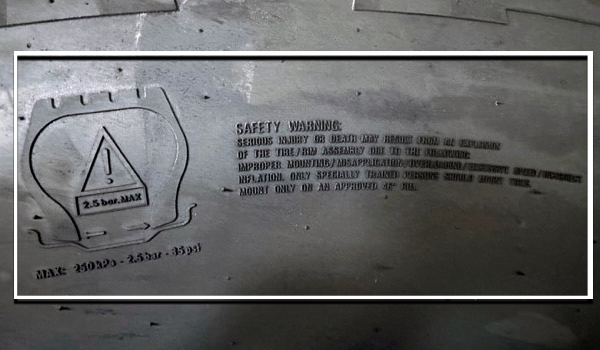
The bead seating marking on the sidewall shows you the maximum inflation pressure to seat the bead. When operating at MAXAM tire’s recommended inflation pressure, you can minimize soil compaction rates and increase fuel efficiency.
Any safety warning information is also located in this area. It is important to read and understand these warnings before use.
Dismounting Groove
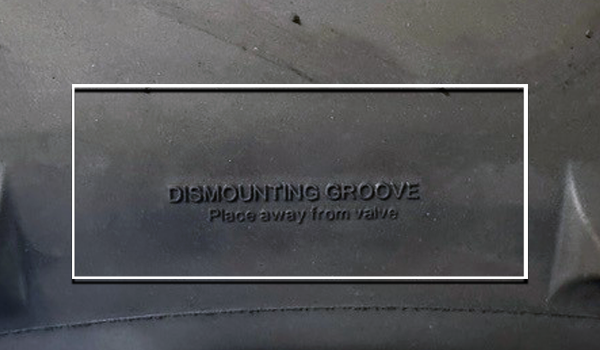
This dismounting groove will be clearly labeled on the side of the tire to allow for ease of removal.
Additional Product Information: Tire size conversion chart for Standard Sizes to Metric Sizes
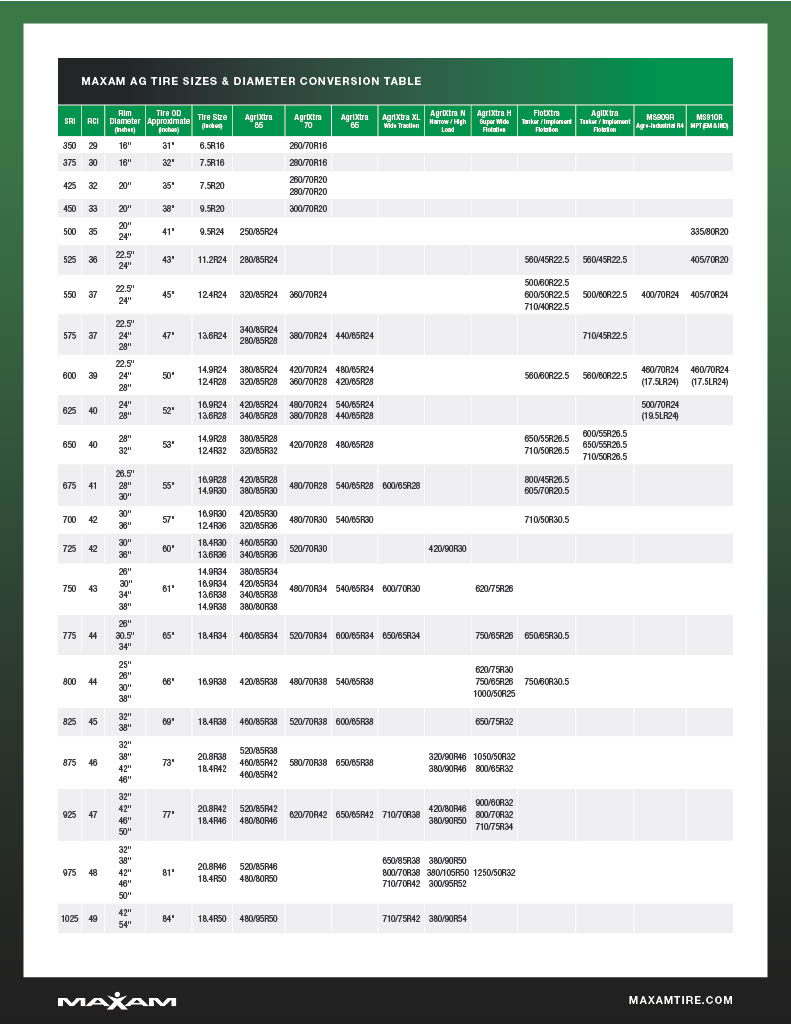
Looking to find the correct size for your application? To make things simple, MAXAM has developed a tire conversion chart that allows you to compare and contrast the various sizes and diameters. In short, to convert from metric to imperial (millimeters to inches), you can divide the number by 25.4 to get the inches equivalent. If you are looking to convert from imperial to metric, simply multiply by 25.4 to get the millimeter equivalent or you can use the below chart: