MAXAM on Carbon Sequestration/ Reduction & How Our Tires Can Help Reduce Rates
AG Technical Bulletin – Do you foresee carbon sequestration becoming increasingly important to N America producers, how can proper tire selection and air pressure improve soil health, and what specific products and practices can make the biggest difference in regenerative agriculture?
First, we need to understand what carbon sequestration is…
The U.S. Geological Survey defines carbon sequestration as the following:
- Carbon sequestration is the process of capturing and storing atmospheric carbon dioxide.
- It is one method of reducing the amount of carbon dioxide in the atmosphere with the goal of reducing global climate change.
The key drivers of carbon dioxide emissions on our planet are the following:
- Atmospheric carbon dioxide comes from both natural sources as well as human activities.
- Natural sources of carbon dioxide include both humans and animals, which both exhale carbon dioxide as a waste product.
- Human activities that lead to carbon dioxide emissions come primarily from energy production, including burning coal, oil, or natural gas, and as well from farming operations.
Animal manure is used as the primary fertilizer or crop nutrient/booster. Agriculture naturally generates carbon emissions as organic matter in feed or manure decomposes under anaerobic conditions. Through the natural anaerobic process of the fertilizer bonding with the soil, a portion of this process releases methane or carbon gases. Therefore, agricultural soils can either emit or absorb carbon dioxide. The turning of the topsoil during plowing, planting, or fertilization mixes underground carbon-containing molecules with atmospheric oxygen, creating the gases that are emitted into our atmosphere. Some 133 billion tons of carbon, roughly a fourth of all carbon gases emitted by humanity since the early 1800s has been released from soils globally. Agricultural operations emit all three greenhouse gases: carbon dioxide (CO2), methane (CH4), and or nitrous oxide (N20). In addition, larger farming equipment have also impacted carbon emissions in the last 80 years in the quest to improve productivity, crop yields, and ultimately grow food faster.
The challenge for agriculture going forward is how do we mitigate or reduce the impact of carbon emissions in our day-to-day farming or agricultural operations?
As discussed in our previous articles, the primary driver for increased crop results or yields is the impact of soil compaction on the plant’s ability to grow, which inevitably will create some gas emissions as the soil is compressed. Soil compaction occurs when stress is applied to a surface soil, causing artificial densification, or thickening as the air is displaced or pushed out from between the soil grains or pores. This reduces the oxygen content and impedes plant root growth. In agricultural operations when weight or load is applied, it will cause densification due to air and water being pushed or displaced from between the soil grain molecules. Therefore, soil compaction is a normal and inevitable part of agricultural operations, which will also result in gases that will be naturally released by through the anaerobic process of the soil mixed with fertilizers as a source of nutrients under pressure.
Farming requires multiple passes by equipment on tires during the growing cycle to include:
- Fertilization
- Planting
- Crop Spraying
- Harvest
- Plowing or Tillage
When operating tires in a farming application the following elements must be assessed:
- Vehicle speed or compaction speed when operating equipment in the field
- Amount of ground pressure (tire footprint and air pressure caused by axle load)
- The effect of multi-passes on the same area or rows by the equipment
The resulting ground pressure and resulting gas emissions is directly impacted by the tires based on the below contributing factors:
- The total vehicle load per axle and number of tires
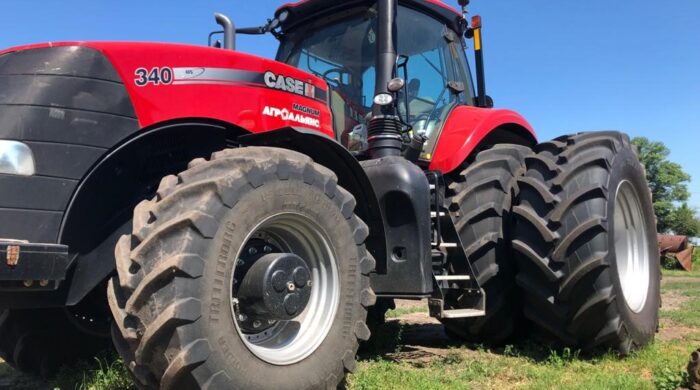
- The distribution of the load on each tire: single, dualled, or tripled per side
- The type of tire construction radial or bias with their corresponding ground pressure
- The tire inflation pressure per the vehicle or towed weight and resulting tire gross flat plate or otherwise known as GFP (contact surface area)
- Surface soil compaction or ground pressure leading to gas emission is mainly impacted by the tire footprint pressures (ex: the larger the footprint, the lower the pressure)
One of the solutions addressed in our last Ag Talk article are traffic or controlled path plans. Controlled path plans are precise traffic lanes designed to reduce soil compaction and ground pressure that will impact carbon emissions by restricting the powered elements of the equipment to travel over exact rows for repeated passes. A traffic path plan will improve vehicle performance, limit the impact to soil conditions, lower gas emissions over time, and improve productivity by avoiding row or traffic overlapping. Overlapping the row or traffic lanes result in wasted energy, escalated fuel costs, and increased soil damage due to the subsequent ground pressure generated with every pass. The use of new GPS-driven, traffic or controlled path technology is also revolutionizing equipment operation by improving vehicle utilization, reducing the impact of ground pressure, and limitingpotential carbon emissions. Keep in mind that the selected equipment will pass over the same field multiple times to deliver seed, nitrogen, fertilizers, nutrients, and pesticides during the growing cycle. From the MAXAM perspective, if the right tire is utilized and in tandem the vehicle employs a traffic (controlled path) plan, the farmer or grower will avoid row skips or overlaps, ensuring reduced soil damage, improving the crop yields, and reducing his carbon footprint. Ultimately, a larger tire footprint (larger diameter, or tread width) will deliver improved performance, reduce ground pressure with the resulting mitigation of carbon gas emissions.
The practice of plowing or tillage after the harvest is considered the most to blame for the erosion or increased emission of gases from the soil, as the tillage processes cuts or turns the soil which exposes the underlayers to the surface, and releases trapped gases. Some of the solutions that have been proposed to reduce erosion and carbon emissions are variations to current farming practices as detailed below:
- Strip Tillage or Strip Till: is a newer soil conservation process that utilizes minimum tillage by limiting the soil disturbance to the row or strip that will be seeded in the spring. The more challenging part of this process requires farmers and growers to make multiple trips to cover their fields, increasing soil compaction and ground pressure. It is estimated that 60% of all North American row crop farms still use strip till as the primary practice for soil preparation before winter.
- No Tillage or No-Till: No-till farming is the greatest reducer of soil erosion specifically in sandy or dry soils and especially on sloping or hillside terrain farming, almost eliminating soil turnover that significantly reduce the emission of soil carbon in the air. The practice of no till increases the amount of water that can infiltrate the soil, helping to increase the retention of organic matter, and improving overall nutrients in the soil. In a no till environment, tires are subjected to more field hazards or increased stubble damage as the residual crop stalks and material are inherently in the path of the tires. This does not eliminate the need for reduced soil compaction. There are various methods of planting from sod seeding to surface seeding depending on what the intentions are with the previous crop harvested. About 25% of North American farms utilize no till as their conservation practice of choice and to improve or reduce carbon emissions. This number is growing annually.
- Use of Cover Crops: A final conservation or action than can reduce carbon emissions is to use or rotate fields with crop residues and/or cover crops such as small cereals, legumes, or other fast-growing vegetation. The crops are not planted for crop harvest purposes, but with the purpose to reduce erosion and enrich soil with nutrients, improved nitrogen retention, and finally carbon-rich residue matter. In practice, cover crops can be planted over the winter season to help reduce erosion, as well as to reduce carbon emissions while allowing that part of the farmers field to recover some soil nutrients and reduce carbon emissions.
MAXAM radial agricultural tires have been developed to deliver performance in any soil conditions worldwide. Our objective is to bring to market radial products in the right sizes, with the right load capabilities, that when operated at the right air pressure will deliver the value and performance our customers expect from MAXAM. Backed by a world-class warranty program, our radial agricultural tires are manufactured to maximize performance, reduce soil compaction, improve carbon emissions, and increase your yields! Try the MAXAM advantage in your agricultural operations today!
For additional information, contact your local representative or visit us at maxamtire.com.