MAXAM on Operator Tips to Reduce Soil Compaction
AG Technical Bulletin – How much soil compaction (% wise) is typically done on the first pass, what are recommended tips relative to defining traffic paths (easy operator changes) and run conditions (dry or wet) to reduce soil compaction, and do you have a recommendation on penetrometer usage to determine level and depth of compaction?
In agricultural operations, the primary driver for increased crop results or yields is the impact of soil compaction on the plant’s ability to grow. Soil compaction occurs when stress is applied to a surface soil causing artificial densification or thickening as the air is displaced or pushed out from between the soil grains or pores reducing the oxygen content and impeding plant root growth. In agricultural operations when weight or load is applied, it will cause densification due to air and water being pushed or displaced from between the soil grain molecules. Therefore, soil compaction is a normal and inevitable part of agricultural operations.
Soils will vary around the world, but they are essentially made up of the following materials in various amounts: clay, silt, sand, organic materials, and water. Depending on the amount of content of the various components listed above, will determine the soil porosity of the field. Understanding the type of soil and moisture conditions a farmer or grower is facing will help select his equipment utilization, the selected air pressure to carry the load, with the intent to minimize soil compaction and improve his yields.
Soil Compaction is impacted by the following materials:
- Initial soil pore volume (porosity of the soil/mix of soil)
- Perceived or measure water content in the soil (predominant influencer)
- Vehicle speed or compaction speed when operating equipment in the field
- Amount of ground pressure (tire footprint and air pressure caused by axle load)
- The effect of multi-passes on the same area or rows by the equipment
Ground pressure is therefore directly impacted by the tires working the field based on the below contributing factors:
- The total vehicle load per axle and number of tires
- The distribution of the load on each individual, dulled or tripled wheel position
- The type of tire construction radial or bias with their corresponding ground pressure
- The tire inflation pressure per the vehicle or towed weight
- The tire GFP or “gross flat plate” or contact surface area because of tire tread dimension and lug design
- The type and weight of the selected implement in operation
- The amount of power applied and subsequent ground slippage (2WD vs. MFWD, or 4WD)
- Surface soil compaction is mainly impacted by the tire footprint pressures (ex: the larger the footprint, the lower the pressure)
- Deep soil compaction is the resulting function of utilized equipment weight and repeated passes but is largely impacted as well by the type of soil and moisture content
Proposed Solutions to Reduce the Impact of Soil Compaction:
A widely accepted solution is “traffic or controlled path plans”. Controlled path plans are precise traffic lanes designed to reduce soil compaction by restricting the powered elements of the equipment to travel over exact rows for repeated passes. A traffic path plan will improve vehicle performance, limit the impact on soil conditions, and improve productivity by avoiding row or traffic overlapping. Overlapping the row or traffic lanes results in wasted energy, escalated fuel costs, and increased soil damage due to the subsequent ground pressure generated with every pass. The use of new GPS-driven, traffic or controlled path technology is revolutionizing equipment operation by improving vehicle utilization and reducing the impact of ground pressure (i.e.: soil compaction) on crop yield. Keep in mind that the selected equipment will pass over the same field multiple times to deliver seed, nitrogen, fertilizers, nutrients, and pesticides during the growing cycle. From the Maxam perspective, if the right tire is utilized and in tandem, the vehicle actively employs guidance technology or employs a traffic (controlled path) plan, the farmer or grower will avoid row skips or overlaps, ensuring reduced soil damage, and improve the crop yields.
Tire Tip #1: Utilizing the right tire size, at the right air pressure to increase your tire footprint will result in reduced ground pressure or soil compaction = greater yields!
Tire Tip #2: Use a penetrometer to accurately track soil compaction in your fields.
- A penetrometer is a tool that will allow a farmer or grower to determine the amount of soil compaction on his field. A penetrometer can help determine how machine loads or axle loads are impacting ground pressure and the resulting soil compaction.
- The information gleaned can also be used to review and change traffic patterns or row alignment to reduce the impact of soil compaction and increase crop yields.
Active fieldwork during dryer soil conditions is another practical solution that allows for better soil structures and improved yields in the mid or long-term. Employing preventative measures such as field drainage helps reduce soil moisture content. Additionally, the use of lime to treat the soil reduces acidity and improves both fertility and oxygen content levels. Dryer soil conditions ultimately allow for “no-tillage” planting, and the use of residue or remanent organic materials that will result in dryer soils with decreased deep soil compaction. Finally, employing both crop rotation and controlled path field tillage before planting is also good practice for reducing soil compaction over time. Another consideration is that dryer soils have greater weight-bearing capacity when compared to wet soils under similar pressure or loads.
Tire Tip #3: The most critical consideration to reduce compaction is to avoid any hard tillage work when soil conditions are extremely wet.
A larger tire footprint (larger diameter, or tread width) will deliver improved performance and reduced ground pressure. You can also impact your tire footprint size by reducing or managing the inflation pressure using scales to weigh each vehicle axle (the lower the pressure: the larger or longer the footprint), resulting in reduced ground pressure. Therefore, a larger tire footprint reduces ground pressure thus reducing soil compaction by increasing the ground coverage area or tread area:
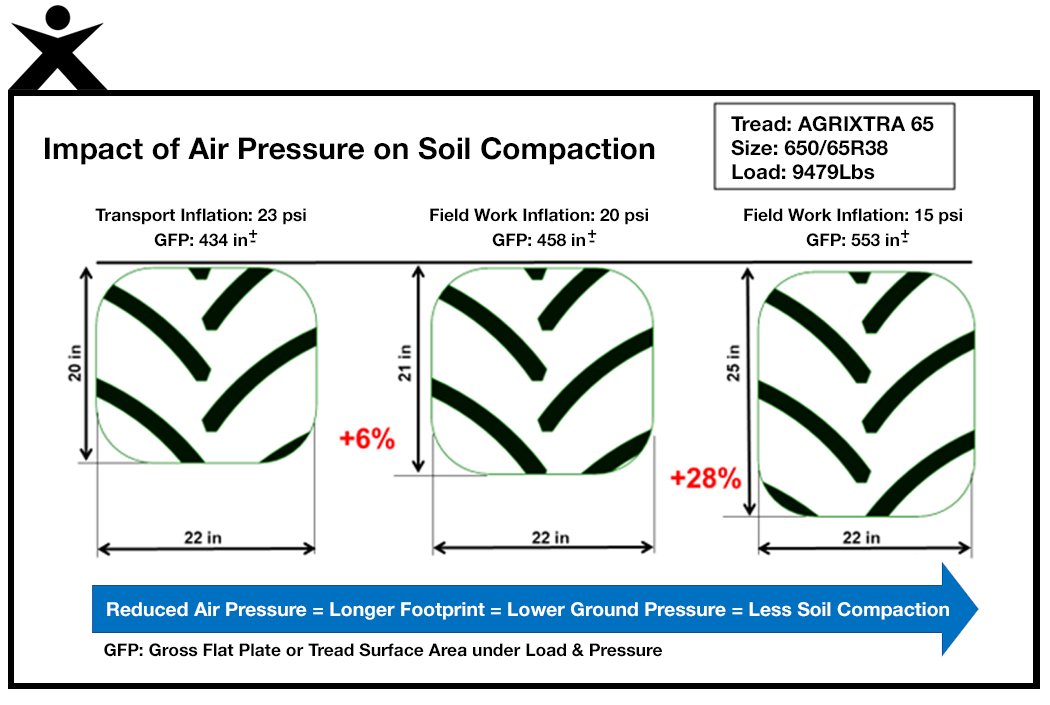
Tire Tip #4: Utilizing tires with a longer or larger contact areas coupled with less field passes will ensure reduced soil compaction.
MAXAM radial agricultural tires have been developed with the load and speed capability to deliver performance in any soil condition worldwide. Our objective is to bring to market radial agricultural products in the right sizes, with the right load capabilities, that when operated at the right air pressure will deliver the value and performance our customers expect. Backed by a world-class warranty program, our radial agricultural tires are manufactured to maximize performance, reduce soil compaction, and improve your yields! Try the MAXAM advantage in your agricultural operations today!
For additional information, contact your local representative or visit us at maxamtire.com.