The data is clear: reducing tire pressure is one of the most effective ways to combat soil compaction and boost crop yields. With modern VF tires and IF tires from leading tire manufacturers like MAXAM, operating at a single digit psi is transformative.
So, why are many growers still hesitant to lower their inflation pressure, and what does it take to do it right? This guide breaks down the barriers, the technology, and the undeniable benefits of embracing low-pressure field operation.
Why Low Air Pressure is a Game-Changer for Agriculture
Agricultural tires are unique. Their large air chamber and multi-tire setups allow them to carry heavy axle loads at remarkably low pressures. The primary goal? To minimize soil compaction.
The fundamental principle is this: Lower air pressure = a larger tire footprint = better flotation and less soil compaction. A larger tire footprint distributes the machine’s weight over a greater area, reducing the pressure on the soil. This preserves soil structure, improves soil water infiltration, and creates an optimal environment for root growth, directly leading to healthier plants and improved crop yields.
The Tech Behind Low Pressure: Radial, IF, and VF Tires
The evolution of tire construction has made single-digit operation a reality. Here’s how it works:
- Standard Radial Tires: The tire casing carries about 20% of the load, while the pressurized air carries 80%.
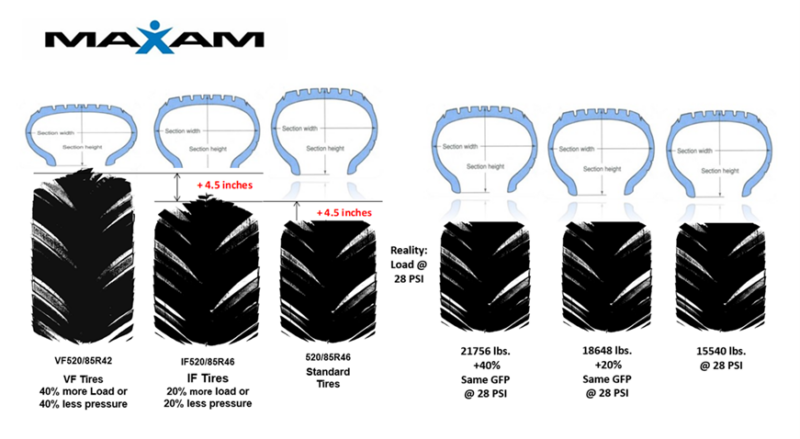
- IF (Increased Flexion) & VF (Very Increased Flexion) Tires: These advanced radial tires feature a more flexible tire sidewall and reinforced casing. A VF tire, for example, can carry the same load at 40% lower air pressure than a standard radial, or 40% more load at the same pressure.
Benefits of VF/IF Technology:
- Massive Flotation: Operating at -40% inflation pressure creates a long, wide tire footprint, dramatically reducing ground pressure.
- Superior Traction: A larger contact patch means more lugs gripping the soil, improving traction and reducing rolling resistance and tire slip.
- Enhanced Durability: Despite the extreme flex, VF tires are engineered with advanced materials for higher heat resistance, ensuring long tire life.
- Improved Stability: The larger contact area provides greater machine stability on slopes and during field operation.
Why Farmers and Growers Hesitate to Lower PSI
Despite the proven advantages, old habits and perceptions persist. Here are the common concerns we hear from producers:
- The “Flat Tire” Fear: Tires at 9 PSI look underinflated, creating a perception of being vulnerable to damage.
- Roading and Fuel Anxiety: The worry that lower air pressure will increase fuel consumption and be unsafe at higher speeds on the road.
- The Inconvenience Factor: Manually adjusting air pressure between field and road is seen as time-consuming and cumbersome.
- Comfort with the Status Quo: Many are accustomed to a “set-it-and-forget-it” pressure of 16-18 PSI that they believe works for all tasks, from tillage to running a sprayer or loader.
How to Safely Run Low Pressures
Adopting a single-digit PSI strategy requires the right equipment and practices. Here’s what’s needed:
- The Right Tires: Invest in VF or IF tires designed for this purpose. Always consult the manufacturer’s inflation tables based on your actual axle load and tire size.
- Proper Ballast: Correct ballast is crucial to ensure the tire is operating at its optimal pressure for the load, maximizing fuel efficiency and performance.
- Central Tire Inflation Systems (CTIS): This is the ultimate game-changer. A central tire inflation system allows the operator to adjust the air pressure from the cab—instantly lowering it for field work to maximize flotation and increasing it for road transport to ensure safety and fuel economy at higher speeds. An onboard compressor makes this process seamless.
MAXAM’s Commitment to Smarter Farming
At MAXAM, we engineer our VF and IF tires to deliver maximum performance and durability. Our tires are built to handle the rigorous demands of low-pressure operation, giving you the confidence to reduce soil compaction, improve fuel economy, and ultimately, enhance your farm’s productivity and sustainability.
Don’t let hesitation hold back your operation’s potential. Embrace the technology that allows you to run lower pressures safely and efficiently.