What is Rolling Resistance, why is it important consideration for fuel usage in transport mode, what are main contributors to energy loss, what tactics can a producer use to minimize, and what specific tire attributes can help reduce the impact?
Rolling resistance is used to explain the physical reaction between two objects in contact acting against each other. In the case of all tires ,specifically AG tires, it is the force against the forward motion of a tire against the ground when force or engine power is applied. In all applications, there are three forces that the tire must overcome to move the tractor in the working direction forward or in reverse:
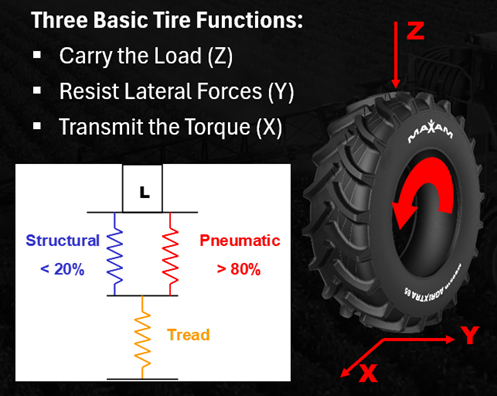
- X Force is the forward or backward force to transmit the engine torque.
- Y Force is the lateral forces caused by the side-to-side forces as the tire deforms or achieves “Plastic Deformation” due to the air pressure required to carry the weight, in relation to the Z force or vertical load flexing.
- Z Force is the vertical force caused by the suspended load or vehicle load acting on the tire.
The X Force in the above diagram is the applied force that transmits the engine torque (or power which overcomes the rolling resistance), also known as tire slip, providing the forward or rear motion to move the machinery.
“Plastic Deformation” is the temporary (at times permanent) tire distortion that can occur. For example, when the tire compresses, it “deforms” the sidewall to flex as it stretches under the vertical load while in contact with the surface, the surface reacts to such force and changes either temporarily or permanently based on the vertical and forward forces applied. As the tire engages with the contact area, whether that is loose soil, packed soil, gravel, rocks, or paved surfaces, the force required to overcome resistance to the tire is called rolling friction or drag, which is rolling resistance.
The evolution from wood/steel tire to rubber tires is because the flexibility rubber exhibits in its ability to transmit energy despite the tire deformation under the “flexing” load and torque to overcome rolling resistance. In essence, rubber can transmit the energy which forwards motion, overcoming the rolling resistance that acts as a “resistant counter energy” that pushes back. Rubber tires experience a physical reaction called “hysteresis” which is the result of repeated cycles of rubber deformation and recovery with every tire rotation while engaging the above three forces. Therefore, the “hysteresis” effect is a positive element that allows the forces acting on the tire to achieve forward motion, while accounting for the energy loss associated with rolling resistance between the surfaces. Rubber tires also contain the “viscoelastic” characteristic, known as the deformation against the surface in contact and its ability to return to its original condition repeatedly, providing reliability..
There are other factors that can influence how a tire’s hysteresis allows its rolling resistance. This includes the working surface deformation such as the roadbed, the surface adhesion between the contact areas, or a paved road vs. a dirt road, concrete vs. sand, etc., the looser the material the greater the friction between surfaces.
Unfortunately, farmers and growers can’t do much to change the physical elements of the tire as tires are to deliver the power necessary to overcome the rolling resistance. However, there are some best practices farmers can implement in order to get the best tire performance:
- Inflate the tires to the correct cold inflation pressure based on the axle load and required work speed, so the tire can absorb the heat and overcome the hysteresis.
- The right air pressure will minimize ground compaction and reduce the “Plastic Deformation” of the soil or ground.
- Greater crop yields can be achieved if soil compaction is minimized by using the best tire footprint.
- The right air pressure will improve tire wear and reduced sidewall deflection giving the optimum tire gross flat plate or footprint while minimizing hysteresis.
- The right air pressure will ensure the tire can transmit the forces necessary to overcome rolling resistance , allowing improved fuel efficiency and reduce tire slip.
- The right air pressure will ensure greater productivity in the field as the tire’s footprint and traction will deliver increased traction, overcoming the rolling resistance required to work the field efficiently.
MAXAM’s agricultural product range has been engineered to ensure the optimal contact patch without compromising the steering, flotation, or traction, providing maximum efficiency and overcoming rolling resistance. MAXAM is constantly developing new VF tires sizes to not only complement our existing offer, but to meet the evolving demand for higher load, platform, and power.