Did you know that 70% of forklift accidents could be prevented by operator training and retraining? Each compensation claim can average $41,000 and each safety violation costs up to $13,000. While it’s critical to maintain your forklift trucks, it’s also equally important to ensure your forklift tires’ safety is maximized as they may have a bigger impact than you think.
Here are the five factors that affect tire safety:
- Environment
- Application
- Equipment upkeep
- Operator training
- Warehouse efficiency
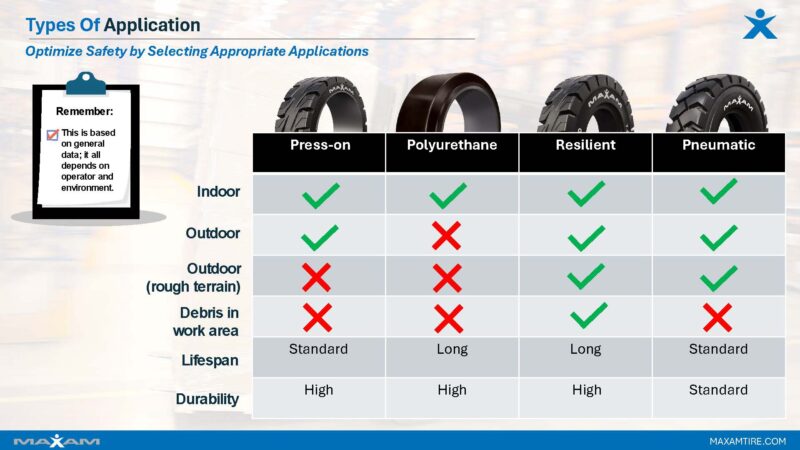
In addition to those five tire safety factors, it’s also important to consider what type of application is appropriate for your warehouse and operations. Below is a general chart that outlines the type of tire by application.
Regardless of your operation needs and application, maintaining your lift truck’s stability is critical to avoid tipping. Typically, forklift becomes unstable in the following scenarios:
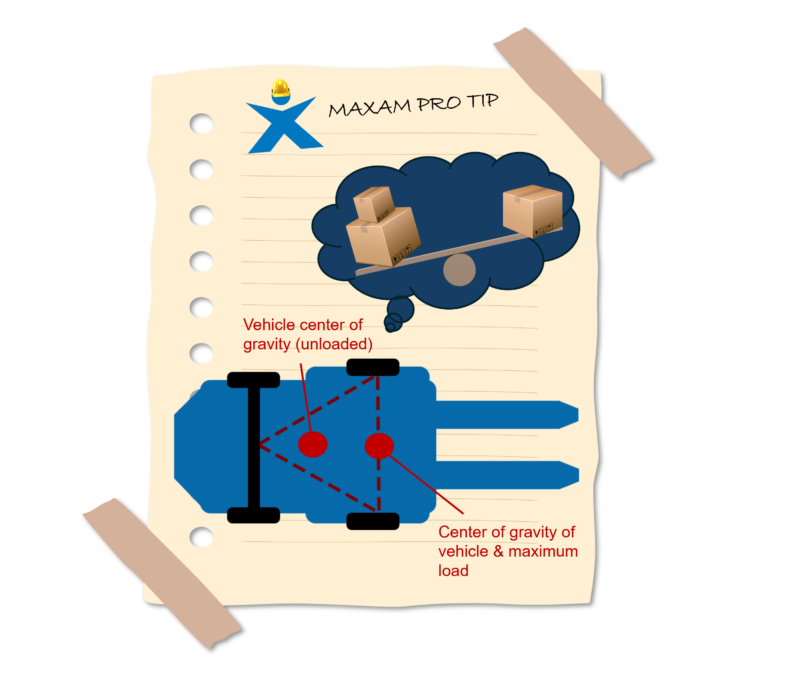
- If it falls outside of the “stability triangle” (from the center of the rear axle to the front wheels), a tip will likely occur.
- Driving down a ramp when the center of gravity moves too far forward.
- Shark turns when center of gravity shifts too far to the left/right of the wheelbase.
Below is a guide on how to maintain the balance of your forklift, loaded and unloaded. Essentially, you want to remain inside the “stability triangle” to maintain stability and by doing so, you’re helping your forklift tires to last longer.
We’ve discussed in the past the most common misapplication tire breakdown in this article, where we list operational and environmental safety opportunities and how to maximize your forklift tires efficiency and tire life.
In addition to ensuring how environment and operation play a role in your forklift tires’ longevity and performance, it’s important to consider whether your shift is on the light use side or heavy shifts side, this also impacts your operator’s comfort. Below is a chart that outlines how forklift tire’s quality impacts safety and efficient operation. It’s worth considering a more premium forklift tire if your operations have heavy shifts, which can be measured by hours run, load carried, ground quality, distance traveled and operator comfort.
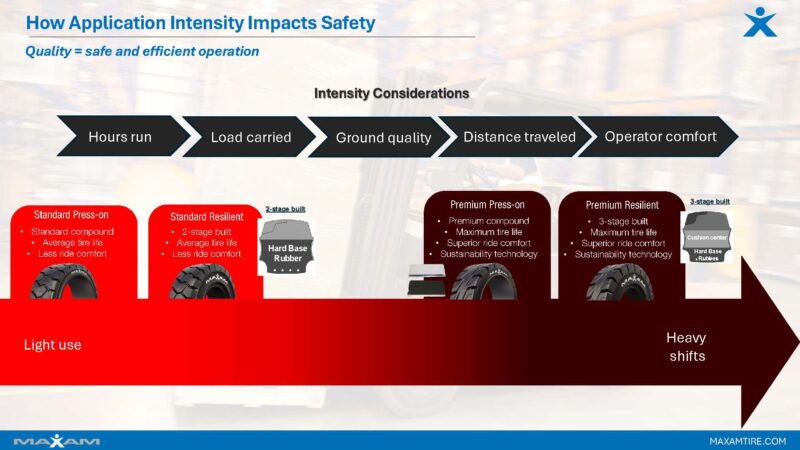
Facts to consider are that the operator will absorb 84% of shock if a tire is 40% overworn, which results in forklift’s transmission working harder to turn the tires, resulting in a potential breakdown. This is why it’s critical to consider proper tire care.
In summary, forklift tire safety has a significant impact on your operation when it’s maximized. When being followed properly, you will achieve maximum productivity and ultimately ensuring the safety of your people.
Want to learn more? Watch our webinar, featuring our forklift tire experts: Robbie Gillis, Material Handling Segment Manager at Maxam Tire, and Matthew Fye, Material Handling Regional Manger for Midwest Region at Maxam Tire, they will break down each important factor to maximize your forklift operation’s safety.
Watch Top 5 tips to maximize forklift tire safety and efficiency webinar:
Download Top 5 tips to maximize forklift tire safety and efficiency webinar presentation